Wine
October 02, 2026 | C.C. Pereira
1 gal juice(s)
1 qt sugar
5 g (1 package) dry active wine yeast
Combine selected juice(s) and sugar in a large pot. Heat to 90°F, stirring occasionally, until sugar dissolves. Remove from heat, and let cool to 55-85°F.
Refrigerate a sample of the liquid (6 oz, or enough to allow a hydrometer to float in the liquid, without hitting the sides or bottom of a hydrometer jar) to cool to 60℉, then use a hydrometer to do a gravity test. To do this, pour the sample into the hydrometer jar, then put the hydrometer in the sample, and gently spin the hydrometer. Once the hydrometer stops spinning, ensure that it is still floating without touching the sides or bottom of the hydrometer jar, then take the reading, at the lowest level of the sample. The result of this test is called the 'original gravity' (OG). Discard the sample.
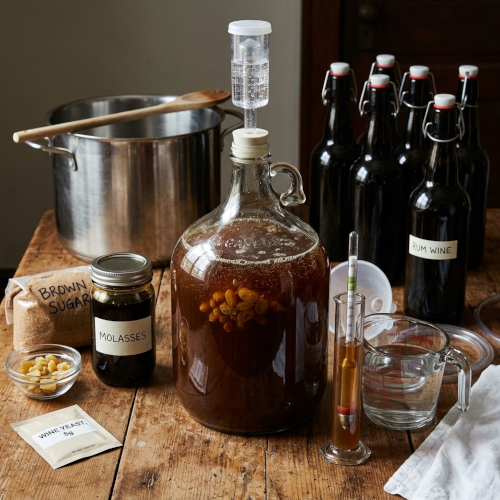
Transfer the liquid to a fermenter (such as a 1 gallon glass jar, that has a small opening in the lid for an airlock to fit snugly into). Stir yeast into the liquid. Put an airlock into the opening of the fermenter, and fill the airlock up to the fill line with clean water. Set the fermenter in a place that is cool (55-85℉) and dark (away from sunlight). Once per week during fermentation, remove the lid from the fermenter, stir contents with a large spoon, and close the lid. When fermentation is complete (within 1 week to 6 months, or when bubbling stops), strain and filter the wine, to remove the solids (such as yeast, pulp, and sediment).
Refrigerate a sample of the wine to cool to 60℉, then use a hydrometer to do another gravity test. The result of this test is called the 'final gravity' (FG). Discard the sample.
Use a funnel to transfer wine to wine bottles with flip top lids, leaving the neck of each bottle of wine empty. Close the lid of each bottle of wine, then store the bottles of wine in a place that is cool (40-65℉) and dark (away from sunlight). Let age for up to 3 years (optional, but the longer it ages, the fuller the body, and in some wines, the better the flavor).
To determine ABV (Alcohol By Volume) and Proof, multiply the difference between OG and FG by 131.25 (i.e., 1.07 OG - 0.97 FG = 0.1 x 131.25 = 13.125% = about 13% ABV x 2 = 26 Proof). Wine is usually 9-15% ABV (x 2 = 18-30 Proof).
Tips:
- Juice(s) with a PH of 3.0-3.5 is recommended. Juice(s) that contain tartaric acid (such as apple, grape, cherry, peach, pear, pineapple, strawberry, mango, or citrus fruit juice), malic acid (such as apple, grape, watermelon, cherry, carrot, or rose hip juice), or citric acid (such as lemon, lime, tangerine, orange, grapefruit, pineapple, carrot, berries, or rose hip juices), may be included, to reduce PH if necessary.
- Including juice(s) rich in tannins (such as grape, pomegranate, berry, or apple juice), helps to increase antioxidants, and improve the texture of wine.
- To thicken or increase body, juice concentrate, syrup, dried fruit (such as raisins, dried figs, or dried dates), fruit nectar, or juice that is rich in pulp (such as apricots, bananas, berries, cherries, dates, figs, mangoes, peaches, papayas, rose hips, etc.), may be added.
- To increase nutrients for yeast (and thereby, alcohol content), add 1 oz raisins.
- If bubbling does not begin within 1 day to 6 weeks, more sugar or yeast may be needed.
Sample Recipe
RUM WINE – Use water instead of juice(s), brown sugar or molasses instead of white sugar, and add 1 oz white raisins.
Vegan Recipes: Beverages
Discover over 200 delicious, easy vegan beverage recipes, that can be made using common everyday ingredients.
Get Your Copy Today!